School attendance is no longer limited to teachers calling out names and marking a register. Modern schools are adopting smart school attendance systems that can automate attendance, improve accuracy, notify parents and connect attendance data with the school's ERP.
But which technology is right for your school — RFID, mobile app or camera-based AI attendance? Each approach has its own strengths, limitations and ideal use cases.
1. RFID-Based School Attendance
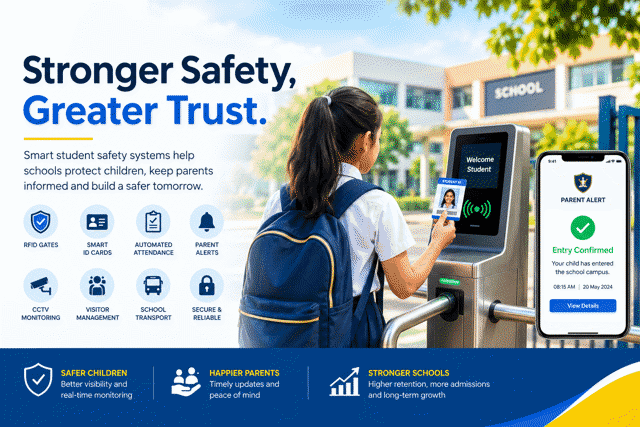
RFID attendance uses a student's RFID-enabled ID card or tag. When the student enters the school through an RFID reader, the system automatically records the attendance and can send an arrival notification to parents.
Advantages of RFID Attendance
- Fast attendance for large numbers of students
- Minimal teacher involvement
- Easy for younger students to use
- Contactless attendance options available
- Can track student entry and exit
- Can trigger SMS or app notifications to parents
- Can integrate with school ERP systems
- Can be extended to buses, libraries and access control
- Does not require storing biometric information
Limitations of RFID
- Students need to carry their RFID card
- Cards can be lost, damaged or forgotten
- Card sharing can create a proxy-attendance risk
- Gate attendance does not necessarily mean classroom attendance
- Requires RFID readers and installation infrastructure
Best suited for: Schools that want fast, automated entry and exit tracking, parent arrival alerts and reliable attendance without using biometric data.
2. Mobile App-Based Attendance
Mobile app attendance allows teachers to mark attendance using a smartphone, tablet or computer. It is particularly useful for classroom and period-wise attendance.
Advantages of Mobile App Attendance
- Very little hardware is required
- Easy and quick to deploy
- Useful for classroom and period-wise attendance
- Teachers can make corrections when required
- Easy reporting and attendance monitoring
- Can integrate with the school's ERP
- No RFID cards or biometric data required
Limitations of Mobile App Attendance
- Depends heavily on teacher involvement
- Manual marking can introduce errors
- Can take time in large classrooms
- Does not independently verify whether a student is physically present
- Requires a teacher's device
- Does not automatically track school gate entry and exit
Best suited for: Schools that need flexible classroom or period-wise attendance and want to start with minimal hardware investment.
3. Camera-Based / AI Attendance
Camera-based attendance uses computer vision and AI to identify students automatically. Cameras can be installed at entrances, corridors or classrooms to record attendance without requiring students to scan a card.
Advantages of Camera-Based Attendance
- Hands-free attendance
- No RFID card is required
- Highly automated
- Can work at classrooms and school entrances
- Low teacher involvement
- More resistant to traditional card-based proxy attendance
Limitations of Camera-Based Attendance
- Higher implementation cost
- Requires cameras and supporting infrastructure
- Lighting, camera position and image quality can affect performance
- Biometric or facial data requires careful management
- Privacy and consent requirements need to be considered
- More complex to implement and maintain
Best suited for: Schools looking for highly automated attendance and willing to invest in AI infrastructure and appropriate privacy safeguards.
RFID vs Mobile App vs Camera-Based Attendance
The following comparison provides a quick overview of how the three technologies differ:
| Feature | RFID | Mobile App | Camera / AI |
|---|---|---|---|
| Automated Attendance | ✓ | ✗ | ✓ |
| Teacher Involvement | Low | High | Low |
| Student Interaction | RFID Card | None | None |
| Entry / Exit Tracking | ✓ | ✗ | ✓ |
| Classroom Attendance | Limited | ✓ | ✓ |
| Period-wise Attendance | Limited | ✓ | ✓ |
| Attendance Speed | Very High | Medium | Very High |
| Hardware Cost | Medium | Low | High |
| Card Required | ✓ | ✗ | ✗ |
| Proxy Resistance | Medium | Low | High |
| Parent Arrival Alerts | ✓ | Optional | ✓ |
| Privacy Considerations | Low | Low | High |
| Implementation Complexity | Medium | Low | High |
| ERP Integration | ✓ | ✓ | ✓ |
Which Smart Attendance System Is Right for Your School?
There is no single attendance technology that is perfect for every school. The right choice depends on your school's size, infrastructure, budget and attendance requirements.
Choose RFID if your priority is fast, automated student entry and exit tracking with parent notifications and minimal teacher involvement.
Choose a Mobile App if you mainly need flexible classroom or period-wise attendance with low hardware investment.
Choose Camera/AI if maximum automation and reduced proxy attendance are priorities and your school is prepared for higher infrastructure and privacy requirements.
A Hybrid Approach Can Be Even Better
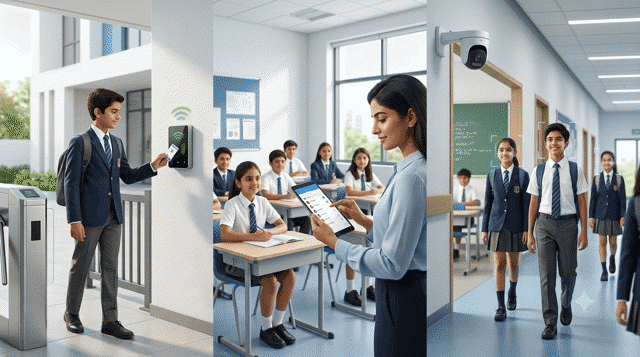
Schools do not necessarily have to choose only one technology. A hybrid attendance system can combine different technologies for different purposes.
- School Gate: RFID for automated entry and exit
- Classroom: Mobile app for teacher-managed attendance
- Central System: School ERP for attendance records and reporting
This approach can provide the convenience of automated entry tracking while still giving teachers flexibility for classroom attendance.
Final Takeaway
RFID, mobile apps and camera-based AI each solve different attendance challenges. RFID is particularly strong for fast school entry and exit tracking, mobile apps offer flexibility for classroom attendance, while AI cameras provide a high level of automation.
For many schools, the best solution may not be choosing one technology over another, but selecting the technology that fits each part of the school's attendance process.