Choosing the right student attendance system is important for schools. The system needs to be accurate and reliable, but it must also work smoothly when hundreds of students arrive within a short period.
Two common options are RFID card-based attendance and biometric fingerprint attendance.
Both technologies can automate attendance and reduce manual work. However, for many schools—especially those with younger students—RFID ID cards can be more practical for daily entry and exit attendance.
The basic difference is simple:
RFID identifies a student through an ID card, while biometric attendance identifies the student through their fingerprint.
RFID vs Biometric Attendance: At a Glance
| Feature | RFID Attendance | Biometric Fingerprint Attendance |
|---|---|---|
| Identification | RFID ID card | Student fingerprint |
| Student interaction | Present card near reader | Place finger on scanner |
| Contact | Contactless | Physical contact |
| Large-group speed | Generally very fast | Can be slower due to repeated scans |
| Younger children | Easy to use | May require careful finger placement |
| Wet/dirty fingers | Usually no issue | Can affect fingerprint capture |
| Hygiene | Contactless | Scanner is touched |
| Forgotten credential | Card must be carried | No card required |
| Lost credential | Card can be replaced | No physical credential |
| Card sharing | Possible | Very difficult |
| Enrollment | Card registration | Fingerprint enrollment required |
| Parent SMS | Can be integrated | Can be integrated |
How RFID Attendance Works in Schools
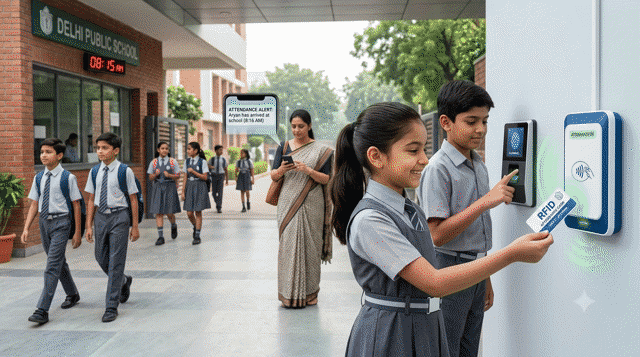
Each student receives a unique RFID-enabled school ID card. When the student presents the card near an RFID reader, the reader detects the card's unique identifier and sends the information to the attendance system.
The system can then:
- Identify the student.
- Record the date and time.
- Mark the student present.
- Record entry and exit.
- Update the school's attendance records.
- Trigger an SMS or other notification to parents, when configured.
RFID readers can be installed at school gates, entrances, classrooms or other designated attendance points. SIM/GPRS-based attendance devices can also communicate through a mobile network, which can be useful where the school does not want to depend on Wi-Fi or LAN connectivity at the installation point.
How Biometric Fingerprint Attendance Works
A biometric attendance machine identifies a student using their fingerprint. During enrollment, the student's fingerprint is registered in the system. During attendance, the student places a finger on the scanner and the captured fingerprint is compared with the registered biometric information.
The major advantage is simple:
The student does not need to carry a physical attendance card.
This makes biometrics attractive where direct person-level identification is the highest priority. However, fingerprint systems also introduce practical considerations in a busy school environment, especially when the users are young children.
Why RFID ID Cards May Be Better for Children
1. Simple for Young Students
For a child, the RFID process is easy:
Show card → Reader detects card → Attendance recorded
The child does not need to understand how to position a particular finger correctly on a sensor. This can be especially useful in primary schools where large groups of younger children arrive together.
Children's fingerprints can be recognized by biometric systems, but child fingerprint capture can involve considerations related to finger size, image quality and positioning. The actual performance depends on the biometric hardware and enrollment process used by the school.
2. Wet, Dirty or Sweaty Fingers
Students do not always arrive with clean and dry hands. After sports, outdoor play, physical education or rainy-weather activities, fingers may be wet, sweaty, dusty or dirty.
Fingerprint recognition depends on obtaining a sufficiently good fingerprint image. With RFID, the student's finger condition generally does not matter because the ID card is what the reader detects.
3. Contactless Operation
Fingerprint attendance requires students to touch the scanner. RFID attendance can be completely contactless, with the student simply bringing the card close to the reader.
For schools processing large numbers of students at the beginning and end of the day, this can also make the attendance process more convenient.
4. Easier Student Enrollment
Biometric systems require fingerprint enrollment for every student. RFID systems mainly require the school to assign an RFID card to the student's profile.
For schools with frequent admissions, student transfers and large numbers of children, card registration can be a simpler administrative process than biometric enrollment.
But RFID Cards Have Their Own Problems
RFID should not be presented as a perfect solution. The technology has some genuine operational limitations.
Lost or Forgotten Cards
A student can leave the card at home, lose it, damage it or forget it in another classroom or on a school bus. The school therefore needs a simple procedure for temporary attendance and card replacement.
Card Sharing and Proxy Attendance
This is one of the biggest weaknesses of RFID when compared with biometrics.
RFID identifies the registered card, not necessarily the person holding the card.
For example, if Student A gives their RFID card to Student B, the system may identify the transaction as Student A's attendance.
Schools can reduce this risk by using student photographs, supervised entry points, appropriate system controls and clear attendance policies.
Card Damage
School ID cards are handled by children every day. Cards can be bent, cracked, scratched or damaged through rough use. Schools should therefore maintain replacement cards and have a process for immediately deactivating lost cards.
Realistic Problems Schools Can Face With Fingerprint Attendance
1. Morning Queues
Consider a school with hundreds or even thousands of students arriving within a 15–30 minute window. Every child has to interact physically with the fingerprint scanner.
If a scan fails and the student has to try again, even a small number of repeated attempts can contribute to queues.
RFID can be attractive in this situation because the student only needs to present the ID card to the reader.
2. Incorrect Finger Placement
Young children may place only part of a finger on the sensor, move the finger during scanning or use a different finger than the one originally enrolled.
This can lead to unsuccessful attempts and require repeated scanning or assistance from school staff.
3. Sweat, Moisture and Dirt
Fingerprint image quality can be affected by the condition of the finger and the quality of the capture process. A student arriving after outdoor activities may not always have ideal conditions for fingerprint scanning.
4. Hygiene
A fingerprint scanner is touched repeatedly by many students throughout the day. RFID, by comparison, can operate without students touching the attendance reader.
5. Fingerprint Enrollment and Maintenance
Schools have to enroll every student and maintain the biometric system. They also need procedures for new admissions, failed enrollment, occasional verification failures, device cleaning and hardware problems.
RFID vs Biometric: Which Is Better for Schools?
There is no single answer that applies to every school. The better technology depends on the school's priorities, student age group, number of students and attendance environment.
RFID May Be Better When:
- The school has many younger students.
- Fast student entry and exit are important.
- Contactless attendance is preferred.
- The school wants to integrate parent SMS alerts.
- The school wants to avoid fingerprint enrollment.
- The attendance point needs SIM/GPRS connectivity.
- The main objective is simple and fast daily attendance.
Biometric May Be Better When:
- Strong person-level identity verification is the highest priority.
- The school wants to eliminate physical attendance credentials.
- Students can reliably use the selected biometric hardware.
- The school is prepared for enrollment and occasional verification problems.
- Preventing credential sharing is more important than contactless operation.
RFID + SMS: More Than Just Attendance
For parents, the most important question is often not simply whether attendance has been recorded. It is:
“Did my child reach school safely?”
An RFID attendance system can be integrated with an SMS service so that a successful scan triggers an automated parent notification.
For example:
Attendance Alert: Your child Aarav entered the school premises at 8:07 AM.
Another example could be:
Exit Alert: Your child Aarav left the school premises at 2:35 PM.
Schools can also configure different types of alerts depending on the attendance system, such as arrival, departure, absence or late-entry notifications.
This makes RFID useful not only as an attendance solution, but also as a tool for parent communication and student safety.
What About a School Without Wi-Fi?
One advantage of a SIM/GPRS-enabled RFID attendance device is that the device can communicate through a mobile network instead of relying on the school's Wi-Fi or LAN connection.
This can be useful for:
- School gates where network infrastructure is limited.
- Temporary attendance locations.
- Portable attendance setups.
- Multiple attendance points.
- Locations where installing LAN cabling is inconvenient.
The exact connectivity architecture depends on the device, SIM network, server and software platform, but the principle is straightforward: the attendance device can transmit attendance data over the mobile network.
RFID vs Fingerprint: Which Has the Bigger Practical Advantage?
The answer depends on what the school values most.
If the priority is strong person-level identity authentication without a physical credential, fingerprint biometrics has a clear advantage.
If the priority is fast, simple and contactless attendance for large groups of students, RFID can have a practical advantage.
For younger students, RFID can also reduce the need for staff to repeatedly help children position their fingers correctly on the scanner.
Final Verdict
For many K–12 schools, particularly schools with younger students and high-volume entry points, RFID ID cards can be a practical alternative to fingerprint attendance.
RFID provides a simple workflow:
Student → RFID Card → Reader → Attendance → Parent SMS
It offers contactless operation, simple student interaction and easy integration with attendance and SMS systems.
At the same time, schools should recognize its limitations. An RFID card can be forgotten, lost, damaged or potentially shared. Biometrics solve the credential-sharing problem more effectively, but introduce their own operational requirements such as fingerprint enrollment, scanner interaction and handling of failed scans.
Therefore, the right question is not simply “Which technology is more advanced?”
The better question is:
“Which attendance system will work most reliably and conveniently for our students, teachers and parents every day?”
For schools where speed, simplicity, contactless operation and parent SMS alerts are priorities, RFID ID cards can be a strong and practical choice.
Frequently Asked Questions
Is RFID attendance better than biometric attendance for primary schools?
For many primary schools, RFID can be easier for children because they simply present their school ID card. Properly designed fingerprint systems can also recognize children, so schools should consider their specific environment and hardware before making a decision.
Can RFID attendance send SMS to parents?
Yes. RFID attendance systems can be connected to SMS services to send automated arrival, departure, late-entry or absence notifications to parents.
What happens if a student loses an RFID card?
The school can deactivate the lost card, issue a replacement and use a temporary or manual attendance procedure until the replacement card is provided.
Can students share RFID cards?
Yes. Card sharing is a potential weakness because RFID identifies the registered card. Schools can reduce this risk using student photographs, supervised entry, attendance policies and appropriate software controls.
Is fingerprint attendance unreliable for children?
No. It is not accurate to say that fingerprint attendance is unreliable for all children. Children can be identified using fingerprints, but schools should consider fingerprint capture quality, finger placement, hardware capability and the practical environment in which the devices will be used.
Which is faster: RFID or fingerprint attendance?
Both technologies can be fast with suitable hardware, but RFID can be particularly convenient at high-volume school entrances because students only need to present their cards rather than physically interact with a fingerprint sensor.
What is the best attendance system for a school?
RFID is particularly suitable where fast student entry, contactless operation, simple use by children and parent notifications are priorities. Biometric attendance may be more appropriate where person-level authentication and elimination of physical credentials are the primary requirements.