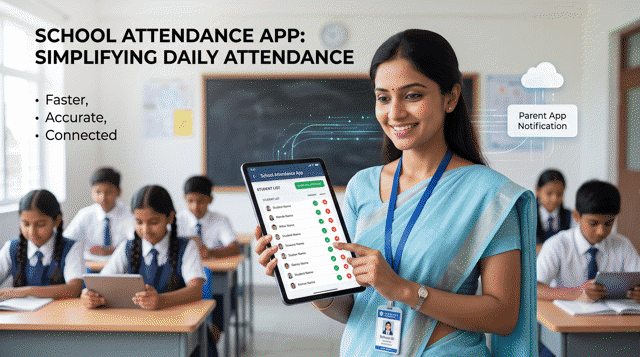
A School Attendance App offers a smarter way to record, manage, and monitor student attendance. By moving from manual registers to digital attendance, schools can save time, reduce errors, simplify reporting, and improve visibility into attendance data.
Why Do Schools Need a School Attendance App?
In a traditional classroom, teachers typically call out students' names and mark their attendance in a register. The information may later need to be transferred to a spreadsheet or school management system.
As the number of students, classes, and campuses increases, managing attendance manually can become increasingly time-consuming. Preparing monthly reports, calculating attendance percentages, checking absences, and finding historical records can add to the workload of teachers and administrative staff.
A School Attendance App brings these activities into a digital system. Attendance can be recorded and stored centrally, making it easier for authorized users to access records, monitor attendance, and generate reports.
Manual Attendance vs. School Attendance App
The difference becomes clearer when the two approaches are compared side by side:
| Feature | Manual Attendance | School Attendance App |
|---|---|---|
| Time Required | Takes time to call names and mark registers | Faster digital attendance recording |
| Data Entry | Mostly manual | Digital and centralized |
| Accuracy | Manual mistakes can occur | Helps reduce manual data-entry errors |
| Record Keeping | Paper registers or spreadsheets | Digital attendance records |
| Finding Records | Requires searching through registers or files | Quick access to attendance history |
| Reports | Often require manual calculations | Reports can be generated from digital data |
| Teacher Workload | More repetitive administrative work | Reduces repetitive attendance tasks |
| Parent Communication | Usually handled separately | Can support digital attendance notifications |
| RFID Support | Not available through the register itself | Can integrate with RFID systems |
| Biometric Support | Not available through manual registers | Can integrate with biometric devices |
| Multiple Classes | Requires managing multiple registers | Centralized management across classes |
| Attendance Monitoring | Limited visibility | Easier monitoring through digital dashboards |
| Data Management | Physical records can be lost or damaged | Centralized digital records with controlled access |
| Scalability | Becomes harder to manage as the school grows | Can scale across students, classes, and campuses |
Key Benefits of a School Attendance App
1. Saves Teachers' Time
Taking attendance every day may seem like a small task, but the time adds up across multiple classes and throughout the academic year.
A School Attendance App can make attendance recording faster and more convenient, giving teachers more time to focus on teaching and student interaction.
2. Helps Improve Attendance Accuracy
Manual attendance depends on teachers and staff entering information correctly. Missed markings, incorrect entries, or mistakes while transferring information can affect attendance records.
Digital attendance helps reduce repetitive manual data entry and provides a more consistent way to maintain student attendance information.
3. Makes Attendance Records Easier to Access
Searching for a student's attendance history in physical registers can be inconvenient, particularly when schools need records from previous weeks or months.
With digital attendance, authorized teachers and administrators can access relevant records more quickly and search attendance information based on students, classes, dates, or other available filters.
4. Simplifies Attendance Reports
Schools often need attendance reports for individual students, classes, grades, or specific periods.
When attendance information is stored digitally, schools can simplify report generation and attendance calculations instead of manually going through registers and calculating percentages.
5. Provides Better Attendance Monitoring
A School Attendance App can give administrators greater visibility into attendance across the school.
Depending on the platform, administrators may be able to monitor daily attendance, absences, late arrivals, and other attendance-related information through digital dashboards and reports.
6. Helps Keep Parents Informed
Parents want to know whether their children are attending school regularly.
A digital attendance system can support timely communication by enabling schools to send attendance notifications or updates to parents, depending on the features available in the system.
This can create a more connected communication process between schools and families.
7. Supports RFID-Based Attendance
Schools that use RFID cards can integrate RFID-based attendance with a digital attendance system.
Instead of maintaining separate manual records, attendance information generated through RFID systems can be captured digitally and associated with the relevant student.
This can be particularly useful for schools looking to reduce manual attendance work while continuing to use existing identification technology.
8. Can Integrate With Biometric Devices
Some schools use biometric devices as part of their attendance or access-control process.
A School Attendance App can be integrated with compatible biometric systems so that attendance information can flow into a centralized digital platform.
This gives schools flexibility to choose an attendance method that fits their operational requirements.
9. Manage Attendance Across Classes and Campuses
For larger schools or educational groups, maintaining separate registers for different classes can make attendance management more complicated.
A centralized School Attendance App can provide a common platform for managing attendance across multiple classes, grades, departments, or campuses.
10. Centralizes Attendance Data
Paper registers require physical storage and can be difficult to manage over long periods.
Digital attendance provides a centralized approach to storing and accessing records, with access controls that can be configured according to the school's requirements.
From Manual Attendance to Smart Attendance Management
A School Attendance App is not simply a digital replacement for a paper register.
The larger benefit comes from connecting the different stages of the attendance process.
Is a School Attendance App Better Than Manual Attendance?
The right approach depends on the size, requirements, and existing processes of each school.
Manual attendance can be sufficient when student numbers are small and attendance requirements are straightforward. However, schools managing larger numbers of students or multiple classes may benefit from digitizing the process.
A School Attendance App becomes particularly useful when a school wants to:
- Reduce the time spent on daily attendance
- Improve the consistency of attendance records
- Simplify attendance reports
- Access historical records easily
- Improve parent communication
- Integrate RFID attendance
- Connect biometric attendance devices
- Manage attendance across multiple classes or campuses
What Should Schools Look for in a School Attendance App?
Before choosing an attendance solution, schools should consider more than just how attendance is marked.
- Easy-to-use mobile or web interface
- RFID integration
- Biometric device integration
- Attendance reports and dashboards
- Student and class-level attendance tracking
- Parent notifications
- Data security and access controls
- Integration with existing school management software
- Support for multiple classes and campuses
- Scalability as the school grows
The system should be simple enough for teachers and staff to use every day without adding unnecessary complexity to their existing workflow.
Conclusion
A School Attendance App can simplify daily attendance by reducing repetitive work, minimizing manual errors, making records easier to access, simplifying reporting, and providing better visibility into student attendance.
For schools looking to modernize their administrative operations, moving from manual attendance to digital attendance can be a practical step toward a more efficient, connected, and technology-enabled school environment.